
Federal Prison Release Destinations
A BOP release can mean return to the community, placement under federal supervised release, or transfer to another custodial jurisdiction. The public locator reports the person’s BOP status. It does not guarantee that all legal restraint ended. BOP cautions that another correctional or law-enforcement system may still hold the individual and that parole or supervised release may apply after prison.
This distinction is essential for Sierra County. A person can leave the Sierra County process on a federal writ and remain in federal custody. A county booking entry that closes does not prove community release. In the other direction, a person who completes a federal term may have an unrelated state, county, or immigration hold. Identify the next custodian before describing the movement.
BOP monthly release statistics reinforce that boundary by excluding transfers to another custodial jurisdiction from the release count. For one named person, use the locator’s release date and status as proof of departure from BOP custody only. Then check the federal docket and any other named agency for the next legal status.
Confirm Federal Prison Releases
The BOP Inmate Locator is the main public search for sentenced federal inmates. It covers federal inmates from 1982 to the present. A register number is the strongest search key. When it is not known, the name search offers age, race, and sex filters that can help distinguish people with similar names.
- Open the official BOP locator and choose a number search when a register number is available.
- Otherwise search the full name and use only the identity filters supported by the record.
- Compare the name, register number, age, race, and sex before accepting a match.
- Read the location and release-date columns together. Preserve the exact status shown.
- If the result says “Released” or “Not in BOP Custody,” note the displayed date and check for another custodian or supervision.
- Use the federal court docket or a records request when the locator does not explain the movement.
A result with no facility and a released status indicates that the person is no longer held by BOP as reported. It does not identify the reason for every movement or the terms of later federal supervision. The Sierra County released inmate records path helps distinguish county, state, federal, and immigration custody when a local case crossed systems.
Note: Match the register number whenever possible because a shared name can produce a convincing but incorrect federal inmate result.
BOP Release Records and Contact
The locator is the first route, while BOP’s Freedom of Information Act process serves requests for more detailed federal custody records. A focused request should include the full name, register number, approximate custody dates, and the exact record sought. Ask for existing releasable records that establish the release date, release type, and any transfer reflected by BOP. Federal exemptions and privacy rules can limit what is produced.
Federal Bureau of Prisons
BOP Inmate Locator
BOP FOIA
General information: (202) 307-3198
Use the locator before contacting the general line. A status question may already be answered there, while a detailed historical request belongs in the FOIA channel. Avoid asking a central office to interpret a county booking or state sentence. BOP records concern the federal system.
A request for a named person should be narrow. Identify the relevant federal case and custody period, request the public portion, and ask for the basis of any withholding. The response may not establish what happened after BOP custody ended if a different agency took control.
Federal Prison Locator Fields
BOP documents a compact set of result columns. Each answers a different part of identity or custody. The public record should be read as a federal custody index, not as a complete criminal case or supervision history.
| Locator field | What it establishes |
|---|---|
| Name | The identity label used in the BOP result |
| Register number | The strongest public identifier for matching the federal record |
| Age, race, and sex | Comparison details that help rule out a same-name result |
| Release date | The release date BOP reports for its custody event |
| Location | The BOP facility or a released-status phrase when no facility remains |
The manifest includes a successful capture of the official federal search and released-status route.
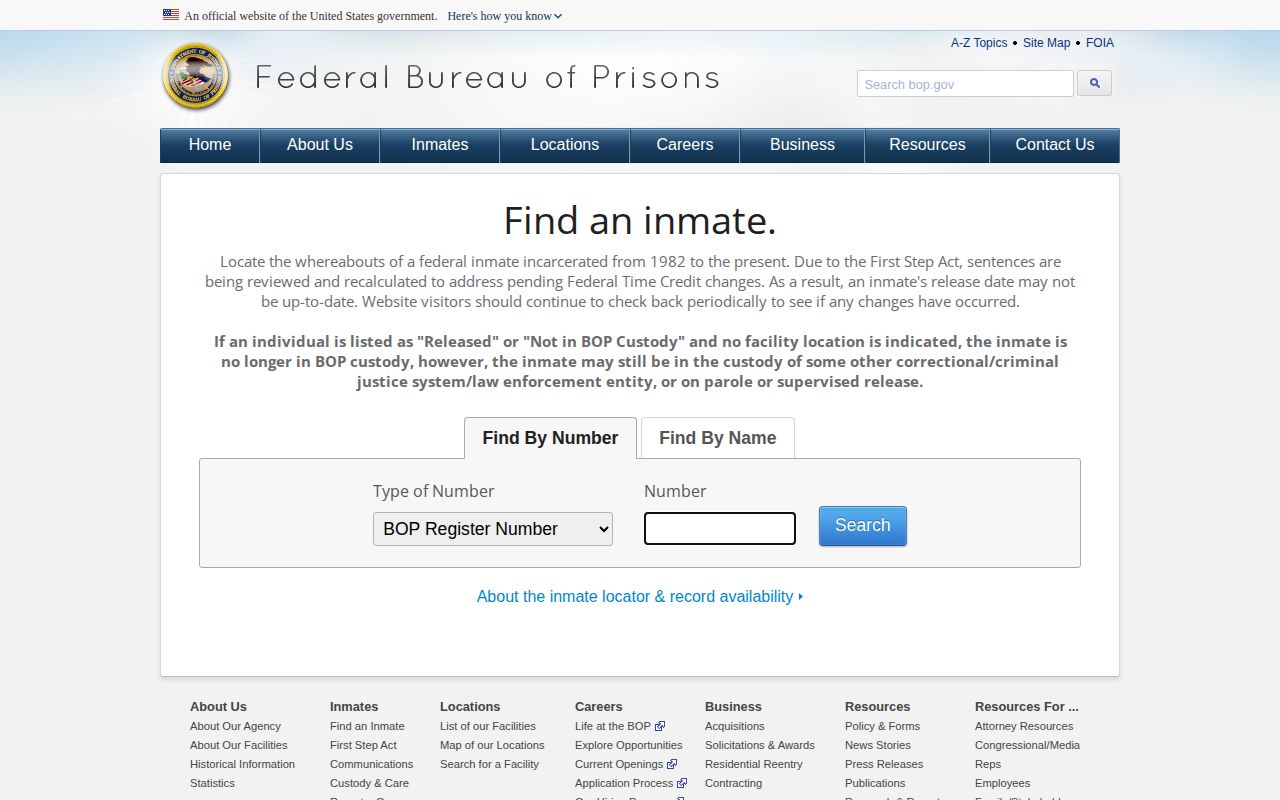
The image establishes the correct BOP search source and the type of release information available. It does not identify the next custodian or prove that supervision ended.
Federal Marshals Release Boundary
U.S. Marshals Service custody is not the same as a sentenced BOP term. A federal pretrial detainee may be held in a contract local jail while the Marshals Service controls the federal detention. That person may never appear as a sentenced BOP inmate. A failed BOP search therefore cannot answer whether a pretrial federal detainee was held, moved, or released.
There is no general public USMS historical inmate roster comparable to the BOP locator. Use the federal court docket to follow detention and release orders. For the federal custody record itself, submit a sufficiently specific USMS FOIA request. Include the full name, federal case number, approximate dates, and the movement or release record sought.
A federal release order can precede physical processing. Another warrant, detainer, or destination can also change the result. Pair the court order with the custodian’s movement record instead of treating the docket time as the prison-door time.
Sierra County Federal Transfers
Sierra County’s local detention model can involve brief local presence for intake, court, or release and placement at an outside jail. When federal authority enters the case, ask which agency held the person at each step. A transfer on a federal writ is continued custody, not release to the community.
The county record should identify the booking number, movement date, legal authority, and destination. The federal docket may identify the federal proceeding. A later BOP record applies only if the person entered the sentenced federal prison system. Temporary Marshals custody remains on the separate USMS and court path.
The systems should form a timeline: Sierra County custody, any outside holding jail, federal transport or detention, sentenced BOP custody if applicable, and the later reported BOP release. Missing one link can turn a handoff into a false release claim. Confirm each change with the agency that made it.
Note: County release, federal transfer, BOP release, and final discharge are separate events that may occur months or years apart.
Federal Prison Release Records
A complete federal release check separates the court’s legal action from the custodian’s physical movement. The federal docket can show detention orders, a judgment, sentence changes, and supervised-release terms. The BOP locator can show the reported federal prison location or release status. A BOP record obtained through FOIA may add the detail needed to trace the custody event. None of those sources should be made to answer a question it was not designed to answer.
Start a timeline with the federal case number and register number. Record the sentencing court, the BOP location when shown, the locator’s release date, and the exact status phrase. If the person entered BOP from Sierra County or an outside holding jail, obtain the local movement record as well. That record can establish when county custody ended and whether the person went to the Marshals Service, BOP, another jail, or a different authority.
Supervised release is a court-ordered period after imprisonment, not continued confinement in a BOP facility. A released locator result does not say that supervised release ended. Read the federal judgment and later docket entries for those terms. In the same way, a BOP release date does not resolve an unrelated state warrant or immigration handoff.
If the public sources disagree, do not combine their dates into a guess. Check whether the court order came before physical processing, whether one record uses a projected date, and whether a transfer produced the status change. The most reliable account names each custodian and labels each date by its actual purpose.